Categories Game: A Strategic Tool for Entrepreneurs and Creators
For entrepreneurs, marketers, and creators navigating a complex business landscape, clarity in decision-making and strategic positioning is essential. The Categories Game offers a structured yet flexible framework to explore relationships between ideas, products, and markets. Unlike generic brainstorming techniques, this method encourages intentional categorization that can reveal overlooked connections, refine messaging, and support long-term planning.
Understanding the Categories Game
The Categories Game is a cognitive exercise where users organize ideas, products, or concepts into defined categories. These categories can be based on function, audience, industry, or any relevant criteria. By systematically placing items into groups, users uncover patterns, distinctions, and opportunities that may not be immediately apparent.
While it may seem simplistic at first glance, the real power of the Categories Game lies in how it’s applied. When used with clear goals and strategic intent, it becomes more than a brainstorming tool—it transforms into a decision-making asset that supports brand positioning, product development, and market analysis.
Strategic Applications of the Categories Game
For business owners and creators, the Categories Game serves as a practical aid in several key areas:
- Market Positioning: Identify where your offering fits within a competitive landscape by mapping similar products or services into distinct categories.
- Product Development: Explore how features or variations can be grouped to serve different customer segments or use cases.
- Content Strategy: Organize blog topics, social media themes, or educational materials into meaningful categories that align with audience needs.
- Brand Messaging: Clarify your value proposition by categorizing your core offerings and how they solve specific problems.
By aligning these categories with business objectives, users can avoid arbitrary decisions and focus on strategic outcomes that drive growth and clarity.
When to Use the Categories Game
The Categories Game is most effective during planning phases, whether launching a new product, refining a business model, or rethinking marketing strategy. It’s particularly useful when:
- You need to simplify complex data or ideas.
- Your team is struggling to align on messaging or positioning.
- You’re entering a new market and need to understand existing categories.
- You’re developing content or educational materials and want a structured approach.
In each of these scenarios, the Categories Game provides a structured way to process information and make strategic decisions without relying on intuition alone.
How to Approach the Categories Game Strategically
Using the Categories Game effectively requires more than randomly sorting ideas into buckets. A thoughtful approach includes the following steps:
- Define Your Objective: What are you trying to achieve? Whether it’s improving customer segmentation or refining your product line, clarity in purpose ensures focused categorization.
- Select Relevant Criteria: Choose categorization rules that align with your goals. These could be based on customer needs, product features, pricing tiers, or usage scenarios.
- Iterate and Refine: Don’t settle on the first set of categories. Test different groupings and see which ones provide the most strategic value.
- Validate with Data: Where possible, back up your categories with market research, customer feedback, or performance metrics.
This method ensures that the Categories Game serves as a practical decision-making tool rather than a random exercise.
Practical Examples of the Categories Game in Action
Consider a small business owner launching a line of eco-friendly household products. Using the Categories Game, they might group their offerings by:
- Room usage (kitchen, bathroom, living room)
- Eco-certifications (plastic-free, biodegradable, refillable)
- Target audience (families, renters, minimalists)
Through this exercise, they may discover that a subset of products appeals to a niche audience they hadn’t previously considered, leading to a more targeted marketing strategy.
Similarly, a blogger developing a content calendar can use the Categories Game to segment topics by reader intent—educational, inspirational, or actionable. This ensures content is organized in a way that aligns with user needs and search intent.
Avoiding Common Pitfalls
One of the biggest risks of using the Categories Game without a clear strategy is falling into the trap of arbitrary categorization. Without defined criteria or goals, the exercise becomes a sorting activity rather than a strategic tool. To avoid this:
- Always tie categories back to business or project goals.
- Be open to rethinking categories as new information emerges.
- Use the game as a starting point, not the final decision-making step.
Remember, the Categories Game is a means to an end—not an end in itself. It should inform decisions, not replace them.
Long-Term Value and Strategic Integration
When integrated into regular planning cycles, the Categories Game can become a recurring strategic asset. For example:
- Quarterly planning sessions can use the game to reassess product positioning.
- Marketing teams can revisit content categories to ensure alignment with evolving audience needs.
- Product developers can use it to explore feature variations and customer preferences.
By revisiting and refining categories over time, businesses can maintain agility while staying grounded in strategic clarity.
Final Thoughts: Using the Categories Game with Purpose
The Categories Game is not a magic solution, but when used with intention and strategic awareness, it can unlock valuable insights. Whether you're a small business owner, content creator, or marketing professional, this tool offers a structured way to explore complexity, clarify direction, and make more informed decisions.
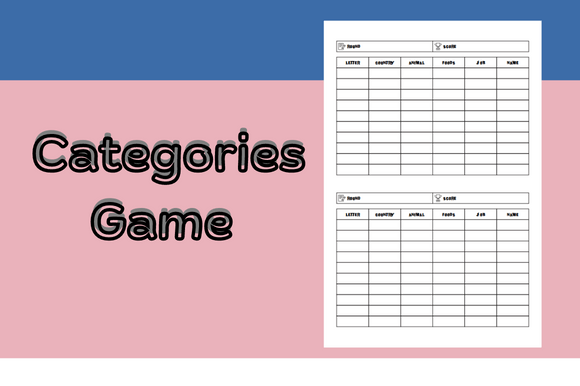
If you're looking for a practical, low-content format that supports strategic thinking, the Categories Game is a versatile choice. With a 50-page PDF format tested for KDP compatibility, it's ideal for those who want to publish thoughtfully without unnecessary fluff. Remember, this is an interior file only—design your own cover to reflect your brand and message.
As you implement the Categories Game in your work, keep asking: How does this help me make better decisions? How can it support my long-term goals? When used with purpose, it becomes more than a tool—it becomes a strategic habit.